Section 6.5 – Poster Presentations
1. PathCape 2018
A virtual poster was presented at a congress, PathCape in 2018 held in the beautiful town of Stellenbosch at a wine farm. The Audit, which I have done has been used for this poster presentation. The congress was an amazing experience. There were sessions with Prof. Tahir Pillay (University of Pretoria) for exam preparation aimed at specifically the Chemical Pathology registrars, which helped with preparations for the Chemical Pathology part 1. There were also various interesting presentations and case discussions presented from registrars, scientists and consultants in the field of Chemical Pathology (Clinical Chemistry). Some of the most interesting presentations which I could attend, were:
- History of HbA1c in diabetes mellitus management – Prof Gillery
- Glycated Albumin – an emerging biomarker for Diabetes – Prof Zemlin
- Performance of glycated albumin for diabetes and prediabetes diagnosis in a Mixed-Ancestry South African population – Marizna Barkhuizen
- Reference interval determination for glycated albumin in a South African population – Marizna Barkhuizen
- A case of X-linked childhood cerebral Adrenoleukodystrophy – Tumelo Satekge
- Seasonal pseudohyperkalaemia in a temperate climate – South Africa – Ashlin Rampul
- The role of Mass Spectrometry in improving the diagnosis and management of Adrenal and thyroid diseases – Prof Soldin
- Endocrine Disruptors – Prof Verena Gounden
- Conflict resolution- Prof Aye Aye Khine
- Spectrum of genetically confirmed mitochondrial disease diagnosed at the UCT/NHLS IMD laboratory over the past 27 years -Surita Meldau
- Two unrelated cases with identical genotype suggest underdiagnosis of hyperphosphataemic familial tumoral calcinosis in Southern Africa – Justine Cole
- Discordant thyroid function test results in a patient with metabolic bone disease – Doreen Jacob
- Identification of pathogenic TP53 and PTEN mutations in circulating cell-free DNA of a patient with triple negative breast cancer – Armand Peeters
My Virtual Posters:
1. Overcoming incomplete laboratory request forms – is an updateable online database the answer?
Overcoming-incomplete-laboratory-request-forms.pdf
Download2. Auto-immune chylomicronemia in a child with hypertriglyceridaemia & acute pancreatitis
2. Annual Research Days – Department of Pediatrics and Child Health 2019 – Red Cross War Memorial Children’s Hospital – Cape Town
Poster:
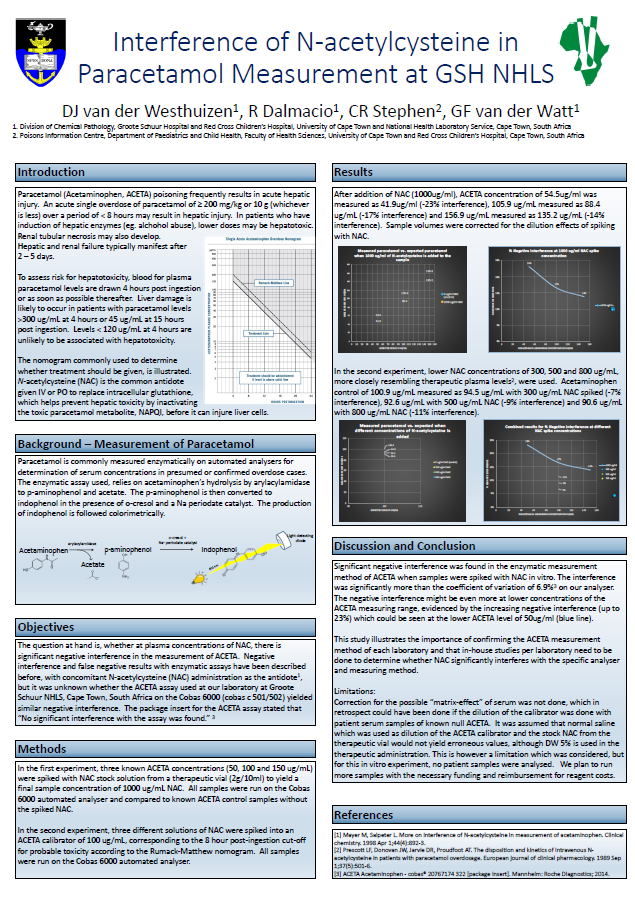
3. PathRed – 2019
Poster:

Invited Speaker:
1. ChemHelp, an automation script to help reviewers of chemistry results.
2. Development of on Online Results Portal for Downtime Results Viewing
4. AACC 2020
A project on which I collaborated with the WITS Chemical Pathology team, Reinhardt Hesse and Jaya George, was selected to be presented as a poster at the international AACC (virtual) conference in December 2020.
The aim of this study was to describe the biochemical and haematological analyte changes seen in COVID-19 patients using South African laboratory data, and to determine the effect of HIV, TB and DM on the risk for acquiring SARS-CoV-2 and the outcomes as measured by intensive and high care admission.
We reported on data for 842,197 individuals, of which 11.7% (98,335) had at least one positive SARS-CoV-2 PCR test, and 88.3% (743,862) tested negative.
Our findings did not support an increased prevalence of either HIV or TB in individuals with SARS-CoV-2 infection but did indicate an increase in disease severity with HIV-positive status. Our findings of clear differences in several commonly measured analytes between the critical and non-critical group suggested that these may be useful in our setting to triage patients.
AACC_poster_Laboratory-changes-and-the-relationship-between-TB-HIV-HbA1c-and-SARS-CoV2-in-SADownload

Section 6.4 – Abstracts
Please see addenda or download from links below:
Section 6.2 – Teaching, Talks & Presentations
TUTORIALS GIVEN BY CANDIDATE
| DATE | TOPIC | STUDENT GROUP (M.B.Ch.B) | DURATION | EVENT/VENUE |
| January 2018, 2019, 2020 | Female Reproductive System | Semester 5 | 2 hrs | Medical School, UCT |
| February 2018, 2019, 2020 | Leukaemia (tumour lysis, syndrome, gout, myeloma) | Semester 5 | 2 hrs | Medical School, UCT |
| February 2018, 2019, 2020, 2021 | Diabetes type I | Semester 5 | 2 hrs | Medical School, UCT |
| February 2018, 2019, 2020, 2021 | Diabetes type II | Semester 5 | 2 hrs | Medical School, UCT, Zoom |
| March 2018, 2019 | Foetal Alcohol Syndrome/Alcohol Metabolism | Semester 5 | 2 hrs | Medical School, UCT |
| May 2018, 2019, 2021 | Renal Failure | Semester 3 | 2 hrs | Medical School, UCT |
| May 2018, 2019 | Blood Gases and Acid- Base Disturbances | Semester 3 | 2 hrs | Medical School, UCT |
| August 2018, 2019 | Cerebrospinal Fluid Analysis | Semester 4 | 2 hrs | Medical School, UCT |
| August 2018, 2019 | Prenatal Screening | Semester 4 | 2 hrs | Medical School, UCT |
| September 2018, 2019, 2020 | Endocrine Causes of Hypertension | Semester 5 | 2 hrs | Medical School, UCT |
| September 2018, 2019, 2020 | Diarrhoea and dehydration | Semester 4 | 2 hrs | Medical School, UCT |
| September 2018, 2019 | Liver Disease | Semester 4 | 2 hrs | Medical School, UCT |
| October 2018, 2019 | Iron metabolism, vit B12, folate, porphyria | Semester 4 | 2 hrs | Medical School, UCT |
| October 2018, 2019, 2020 | Male Reproductive System (PSA, Hypogonadism) | Semester 4 | 2 hrs | Medical School, UCT |
Key issues, take home messages, clinical relevance, areas requiring further exploration
It is a priviledge to be involved in teaching. I am quoting a well known philosopher, Socrates: “I cannot teach anybody anything; I can only make them think.” Another famous quote by Albert Eintein is: “Ones mind, once stretched by a new idea, never regains its original dimensions”. With this mindset it is that I present tutorials. Even though sometimes there are students who are struggling with some of the concepts, I try to explain it in the simplest way possible, hoping to make a difference.
Since COVID, however, it has for me become a bit more challenging to get the students involved in actively participating. It also is more difficult to guage whether people are understanding a concept without facial expression, as lately most people turn their cameras off. Connectivity difficulties and the high price of data in South Africa are likely some of the contributing factors for this.
Nonetheless, the post-COVID way of teaching / tutoring students will remain challenging, but exciting at the same time. Tutoring students is something which I enjoy much and it comes naturally for me. It also forces one to read up about a topic to know as much as possible there is about it.
TALKS/LECTURES/SEMINARS GIVEN BY CANDIDATE
| DATE | TOPIC | EVENT/VENUE |
| 15/05/2018 | The life-giving amines (Vitamins) – part 1 | Combined Metabolic Meeting |
| 05/03/2019 | The life-giving amines (Vitamins) – part 2 | Combined Metabolic Meeting |
| 30/03/2021 | Renin and Hyperaldosteronism – the renal-(o)-pressor | Combined Metabolic Meeting |
| 19/07/2019 | Development of an online results portal for laboratory results during Laboratory Information System (LIS) downtimes | PathReD 2019 conference, Ekurhuleni International Conference Centre, Johannesburg |
| 20/07/2019 | ChemHelp App – an automation script to improve reviewing of Trakcare Chemistry & Haematology results |
PathReD 2019 conference, Ekurhuleni International Conference Centre, Johannesburg |
| 26/09/2018 | Chemical Pathology of Liver Disease | Analytical Staff Teaching (RXH and GSH) |
| 20/02/2019 | Renal failure overview | Analytical Staff Teaching (RXH and GSH) |
| 01/10/2019 | The Male reproductive system | Analytical Staff Teaching (RXH and GSH) |
| 18/02/2020 | Basic metabolic work-up | Analytical Staff Teaching (RXH and GSH) |
| 02/02/2021 | Acute Kidney Injury overview | Analytical Staff Teaching (GSH) |
| 23/03/2021 | Utility of HIL indices in Clinical Chemistry | Analytical Staff Teaching (RXH and GSH) |
Key issues, take home messages, clinical relevance, areas requiring further exploration
Initially, I was anxious when giving a talk in front of an assembly of people. This became better as the field became better known and also as I learned to know more people and staff in the laboratory. One of the principles which I employed to help in giving a talk, which was taught to me by a colleague, Justine Cole, which was quite helpful was to assure/convince oneself of the following facts:
- One can only do your best
- You will never know everything
- When giving a talk on a certain topic, it very likely that one knows more than most other people in the room on that specific topic, so speak to those to whom your topic is new – it will be good revision for the others in any case.
JOURNAL ARTICLES PRESENTED BY CANDIDATE AT UCT MEDICAL SCHOOL
| DATE | TOPIC |
| 26/03/2018 | Congenital Hyperinsulinism |
| 11/06/2018 | TB nano discs in an MS assay to detect biomarkers in pulmonary and extra-pulmonary TB |
| 13/08/2018 | ZFN, TALEN and CRISPR |
| 14/02/2019 | Calcium stimulation testing |
| 29/04/2019 | Disorders of protein folding |
| 20/05/2019 | OSCE – Open source capillary electrophoresis and C4D (capacitatively coupled contactless conductivity detector) |
| 20/06/2019 | Investigations in disorders of sexual differentiation |
| 29/07/2019 | Ecdysteroids as performance enhancers |
| 13/07/2020 | Quality assurance – a touch of stats and a lot of common sense |
| 01/12/2020 | Machine Learning of plasma amino acid analysis |
| 08/03/2021 | History of Iron in Medicine |
Reflective learning commentary
Presenting an article on its own is often daunting, especially when one doesn’t have the proper background knowledge on the topic and also to guage the level at which the audience will enjoy articles often differs. This was likely one of the most challenging things in my preparation of Journal Clubs, but luckily this becomes more easily judgeable as one gets to know the terms and concepts in the field. These meetings are held weekly and it represents a great learning opportunity to all listening and especially those presenting. There are often topics presented which one would never even heard of if one hadn’t attended these meetings. The journal clubs has stimulated many of the fields of study in which I then rabbit-holed into studying things in quite particular detail – often at the arguable extreme wastage of time. Nonetheless, preparing for a journal club is still an exciting activity and part of our job.