Query High Dose Hook effect on Estradiol

HOSP # WARD Andrology Clinic (IVF Clinic)
CONSULTANT   Heleen Vreede DOB/AGE 35 y Female

Abnormal Result

Estrogen 4823 pmol/L in a patient with in vitro vertillization.

Presenting Complaint

The Doctor called, querying if this might be a possible high dose hook effect. They expected a much higher result with this particular patient.

I explained that this is a competitive immunoassay and that high dose hook effect is most likely observed rather with sandwich immunoassays.

History

This patient was undergoing IVF for multiple pregnancy – higher value anticipated (10000 – 12000 pmol/L)

Examination

N/A

Laboratory Investigations

1 in 10 dilution made, result of the rerun was 415 x 10 = 4150 pmol/L (-14% difference).

Other Investigations

Final Diagnosis

The estradiol was indeed likely close to a true result, even though queried by the clinician.

This was confirmed by the duplicate result when running this sample in dilution. The -14% difference from the original result can likely be explained by imprecision from:

  • Pipetting error when doing the manual dilution
  • Imprecision of the analyser
  • Matrix effects when using the universal diluent from the analyser

Take Home Messages

Competitive immunoassays are NOT prone to high dose hook effect, due to the inherent characteristics of the assay.

It is however known that measurement of estradiol at the levels required for IVF is not in the linear range of the assay and that there are likely to be imprecision as noted by the points above.

The measuring range as quoted by the package insert for our Roche Cobas 6000 E2 assay is 18.4 – 11010 pmol/L (LOD to max of master curve). It can however be reported up to 110100 pmol/L for 10-fold diluted samples.

It is however a pity that the reading off the standard curve (signal) cannot be seen on the analyzer’s firmware, as can be seen with routine chemistry analytes eg. liver enzymes etc.

An interesting article which I’ve also forwarded to the doctor is added below.

PDF Loading...


A falsely normal OGTT result?

HOSP # WARD Vanguard Antenatal Clinic
CONSULTANT   Jody Rusch DOB/AGE 32 y Female

Abnormal Result

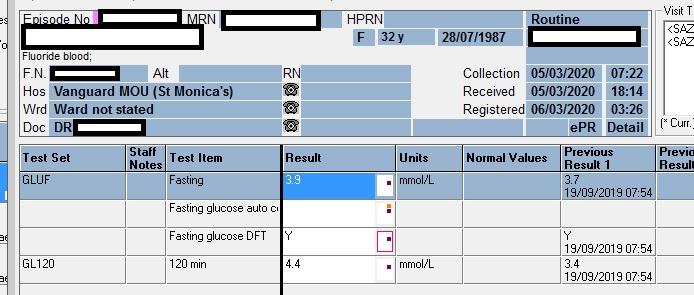
Oral glucose tolerance test with the Sodium Fluoride (NaF) tubes registered by the lab 20 hours after being sampled.

Collection date: 07h22 05/03/2020

Received date: 18h44, 05/03/2020

Registered date: 03h26, 06/03/2020

Please note that samples in our lab are being centrifuged after being registered.

Fasting Glucose 3.9 mmol/L
120 min. Glucose 4.4 mmol/L

Presenting Complaint

My thoughts were, that if the sample isn’t centrifuged in a timely manner, metabolism would still happen, albeit at a slower rate. I also thought that metabolism (glycolysis) would continue if left for a long period (>8 hours) uncentrifuged.

Would you argue the result as given below at “Laboratory Investigations” is reliable, given the following info?

  1. Stability of glucose in whole blood in NaF tubes?
  2. Could this be a false normal result?

The stability spreadsheet as summarized by our lab did not have the stability info for glucose in whole blood:

Figure 1: Stability spreadsheet as summarized by our lab did not have the stability info for glucose in whole blood.

History

Patient is most likely pregnant (being from an antenatal clinic) and this is then a screening test for gestational diabetes.

Examination

N/A

Laboratory Investigations

Other Investigations

Literature search on Google Scholar yielded the following interesting article:

Effectiveness of sodium fluoride as a preservative of glucose in blood.

A Y ChanR SwaminathanC S CockramClinical Chemistry, Volume 35, Issue 2, 1 February 1989, Pages 315–317, https://doi.org/10.1093/clinchem/35.2.315 Published: 01 February 1989

Abstract

How effective is sodium fluoride as a preservative of blood glucose? We compared changes in glucose concentration in fluoride-treated blood specimens with those of heparin-treated specimens. The former declined rapidly during the first hour; thereafter the rate of decrease was slower, and after 4 h the glucose concentration in the blood samples remained stable for up to three days. In contrast, the glucose concentration in the heparin-containing samples declined continuously. During the first hour, however, the rates of decline in the two types of samples were similar. Evidently sodium fluoride takes effect slowly but effectively in preserving glucose in blood for at least three days. Its use, however, is unnecessary if the concentration of glucose is to be measured within the first hour after sampling.

Final Diagnosis

This is likely a true result, meaning the patient is normal and does not have impaired glucose tolerance, nor diabetes.

Take Home Message

Blood glucose is stable for 3 days in plasma from NaF tubes, whether being centrifuged in a timely manner or not.

The stability of glucose in specimens is affected by storage temperature, bacterial contamination, and glycolysis. Plasma or serum samples without preservative (NaF) should be separated from cells or clot within half an hour of being drawn. When blood is permitted to clot and to stand uncentrifuged at room temperature, the average decrease in serum glucose is ~7% per hour (0.28 – 0.56 mmol/L/hour), as a result of glycolysis. Glycolysis can be inhibited by collecting the specimen influoride tubes (1).

(1) Sacks DB. Carbohydrates. In: Tietz NW, ed. Fundamentals of Clincal Chemistry. 4th ed. Philadephia: WB Saunders 1996;351-374.