A case of renal tubular potassium loss

HOSP # WARD Internal Medicine Ward
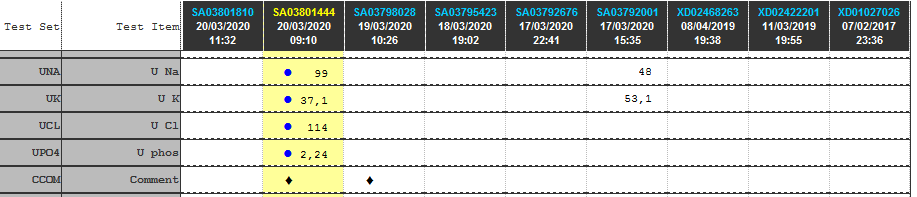
CONSULTANT   Heleen Vreede DOB/AGE 86 year old lady

Abnormal Result

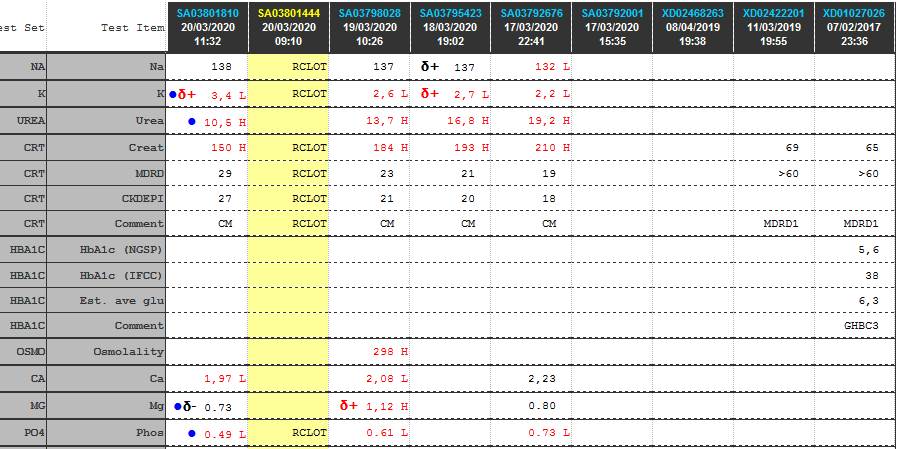
Hypokalemia in a 86 year old lady.

Presenting Complaint

Muscle weakness for the preceding 3 weeks.

History

Known with hypertension, dyslipidaemia and chronic kidney disease.

Presented at a private practice with symptomatic hypokalemia. Patient gave a history of 3 weeks body weakness and dizziness and said she hasn’t been eating well for the prior three weeks.

No other symptoms. No previous medical admissions or procedures.

The patient has just had persistent hypokalemia in hospital despite supplementation. The consultant in Internal Medicine attributed her persistent CMP disturbances to refeeding type syndrome.

In the hospital admission the patient was receiving:

  • Simvastatin 20mg dly PO
  • Calcium carbonate (1g elemental Calcium) q8h PO
  • SlowMag 2 tabs daily PO
  • Metoclopramide 10mg q8h PO

Examination

Not available

Laboratory Investigations
Other Investigations

Transtubular Potassium Gradient (TTKG)

TTKG (Transtubular potassium gradient)………… 8.16

TTKG values between 8 and 9 are considered normal in patients with a normal diet.
TTKG >/= 3 in hypokalemia suggests renal potassium wasting.
Ref: Ethier JH et al. Am J Kidney Dis. 1990 Apr;15(4):309-15. The transtubular potassium concentration in patients with hypokalemia and hyperkalemia.

Values used for calculation:

Urine K…………… 37.1 mmol/L
Serum K……………. 3.4 mmol/L
Urinary Osmol ……… 396 milliosmoles
Plasma Osmol ………. 296 milliosmoles

Fractional Excretion of Potassium (FEK)

FEK ……………………………………. 45 %
Tubular reabsorbtion of potassium (1-FEK)….. 55 %

Values used for calculation:
Urine K…………….. 37.1 mmol/L
Serum K……………… 3.4 mmol/L
Urine Creatinine …….. 3.6 mmol/l
Serum Creatinine …….. 150 umol/l

Final Diagnosis

Take Home Message

A study by Elisaf, M & Siamopoulos, KC (Postgrad Med J 1995; 71: 211-212), clearly showed that in patients with hypokalaemia of extrarenal origin FEK is less than 6.5%, i.e. a FEK more than 6.5% is indicative of inappropriate potassium loss. FEK was more than 9% in all patients with hypokalaemia of renal origin.
The study concluded that in hypokalaemic patients with normal renal function, FEK is a useful tool in the diagnostic approach of hypokalaemia.

Limitations: A random urine sample was used to determine these values. Ideally a 24 hour urine collection should be used and theoretically should provide a more accurate estimation of tubular function. The fractional excretion of potassium is however inherently normalized to creatinine.
No clinical info / medication history was supplied. The most likely cause of inappropriate potassium loss in the urine is medication (iatrogenic) like diuretics and some antihypertensives. Ideally, if a pathogenic, rather than iatrogenic cause of potassium loss is suspected, the patient needs to be free of potassium supplementation and all medication which could influence tubular function must be stopped before analysis of the renal tubular electrolyte handling.

Absorbance values >2, theoretically possible?

I’ve been boggled by this question in the topic ever since I
got absorbance readings on an ELISA test kit >2, up to Absorbance units of
3.5 and so on. 

I speculated how it could be possible, and with George’s
explanation came up with all sorts of theories that plate readers probably
correct for the light path etc.

In my mind, since the formula for absorbance is the following: Abs = 2 – log (%T), my thoughts were that it is impossible to have absorbance values more than 2.  Hence I thought Abs. should be discarded above 2.

I have however seen on this page,
which explained it quite well with a table, that it is indeed possible to
obtain absorbance values >2 if the light source is strong enough and the
spectrophotometer is sensitive enough to obtain accurate readings in this
range.

The theory is however, when the transmittance of <1% happens, log part of the formula (log%T), becomes a negative value.  One thus subtracts a minus, theoretically making absorbances possible to indefinite values.

Absorbance
(optical density) 
Transmittance % 
0 100
1 10           
2 1          
3 0.1       
4 0.01     
5 0.001   
6 0.0001

“At an absorbance of 6, only one 10,000th of one percent of a particular wavelength is being transmitted through the filter (lens). Absorbance is measured with a spectrophotometer, which establishes the light transmission and calculates the absorbance.  However, the spectrophotometer can only measure absorbance up to 4.5 directly.  Beyond this level all values must be extrapolated.  For example, if a 2 mm thick filter is measured to have an absorbance of 3, then it is assumed that a 4 mm thick filter should have an absorbance of 6.”

Obviously there are still limitations to this and the general principle remains that absorbance units should be sought to be <1.8 (actually ideally now that I think of it <1.0) to make the standards and measurements more in the linear range (i.e. %Transmittance less than (100-10^10)=<90), for Abs. <1.  I do think however that spectrophotometers (and plate readers in particular) these days are probably more sensitive than historically and hence one could go up a bit with the absorbance, given the understanding of the limitations regarding imprecision at these Absorbance levels. 

One should understand that the absorbance >2 units does measure light intensity at a %Transmittance value between 99% and 100%, hence the room for error becomes exponentially bigger if the spectrophotometer’s CV is not precise enough at these %T values.

Still to be revealed to me is the fact that absorbance
values I obtained in Spectrophotometers and plate readers often did not
correlate well, even when correcting for the light path length, and I would
probably just need to read more to get proper clarity, or the path length
through the well in the plate reader was not accurately measured by me. 
One way to correct for path length of water could be to measure the absorbance
of the water / solvent at 977nm (infrared; IR) and correct therefor, but most
specs we use don’t have IR measuring capabilities.


Query High Dose Hook effect on Estradiol

HOSP # WARD Andrology Clinic (IVF Clinic)
CONSULTANT   Heleen Vreede DOB/AGE 35 y Female

Abnormal Result

Estrogen 4823 pmol/L in a patient with in vitro vertillization.

Presenting Complaint

The Doctor called, querying if this might be a possible high dose hook effect. They expected a much higher result with this particular patient.

I explained that this is a competitive immunoassay and that high dose hook effect is most likely observed rather with sandwich immunoassays.

History

This patient was undergoing IVF for multiple pregnancy – higher value anticipated (10000 – 12000 pmol/L)

Examination

N/A

Laboratory Investigations

1 in 10 dilution made, result of the rerun was 415 x 10 = 4150 pmol/L (-14% difference).

Other Investigations

Final Diagnosis

The estradiol was indeed likely close to a true result, even though queried by the clinician.

This was confirmed by the duplicate result when running this sample in dilution. The -14% difference from the original result can likely be explained by imprecision from:

  • Pipetting error when doing the manual dilution
  • Imprecision of the analyser
  • Matrix effects when using the universal diluent from the analyser

Take Home Messages

Competitive immunoassays are NOT prone to high dose hook effect, due to the inherent characteristics of the assay.

It is however known that measurement of estradiol at the levels required for IVF is not in the linear range of the assay and that there are likely to be imprecision as noted by the points above.

The measuring range as quoted by the package insert for our Roche Cobas 6000 E2 assay is 18.4 – 11010 pmol/L (LOD to max of master curve). It can however be reported up to 110100 pmol/L for 10-fold diluted samples.

It is however a pity that the reading off the standard curve (signal) cannot be seen on the analyzer’s firmware, as can be seen with routine chemistry analytes eg. liver enzymes etc.

An interesting article which I’ve also forwarded to the doctor is added below.

PDF Loading...


A falsely normal OGTT result?

HOSP # WARD Vanguard Antenatal Clinic
CONSULTANT   Jody Rusch DOB/AGE 32 y Female

Abnormal Result

Oral glucose tolerance test with the Sodium Fluoride (NaF) tubes registered by the lab 20 hours after being sampled.

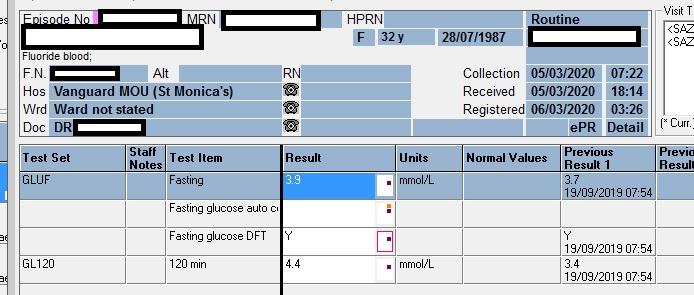
Collection date: 07h22 05/03/2020

Received date: 18h44, 05/03/2020

Registered date: 03h26, 06/03/2020

Please note that samples in our lab are being centrifuged after being registered.

Fasting Glucose 3.9 mmol/L
120 min. Glucose 4.4 mmol/L

Presenting Complaint

My thoughts were, that if the sample isn’t centrifuged in a timely manner, metabolism would still happen, albeit at a slower rate. I also thought that metabolism (glycolysis) would continue if left for a long period (>8 hours) uncentrifuged.

Would you argue the result as given below at “Laboratory Investigations” is reliable, given the following info?

  1. Stability of glucose in whole blood in NaF tubes?
  2. Could this be a false normal result?

The stability spreadsheet as summarized by our lab did not have the stability info for glucose in whole blood:

Figure 1: Stability spreadsheet as summarized by our lab did not have the stability info for glucose in whole blood.

History

Patient is most likely pregnant (being from an antenatal clinic) and this is then a screening test for gestational diabetes.

Examination

N/A

Laboratory Investigations

Other Investigations

Literature search on Google Scholar yielded the following interesting article:

Effectiveness of sodium fluoride as a preservative of glucose in blood.

A Y ChanR SwaminathanC S CockramClinical Chemistry, Volume 35, Issue 2, 1 February 1989, Pages 315–317, https://doi.org/10.1093/clinchem/35.2.315 Published: 01 February 1989

Abstract

How effective is sodium fluoride as a preservative of blood glucose? We compared changes in glucose concentration in fluoride-treated blood specimens with those of heparin-treated specimens. The former declined rapidly during the first hour; thereafter the rate of decrease was slower, and after 4 h the glucose concentration in the blood samples remained stable for up to three days. In contrast, the glucose concentration in the heparin-containing samples declined continuously. During the first hour, however, the rates of decline in the two types of samples were similar. Evidently sodium fluoride takes effect slowly but effectively in preserving glucose in blood for at least three days. Its use, however, is unnecessary if the concentration of glucose is to be measured within the first hour after sampling.

Final Diagnosis

This is likely a true result, meaning the patient is normal and does not have impaired glucose tolerance, nor diabetes.

Take Home Message

Blood glucose is stable for 3 days in plasma from NaF tubes, whether being centrifuged in a timely manner or not.

The stability of glucose in specimens is affected by storage temperature, bacterial contamination, and glycolysis. Plasma or serum samples without preservative (NaF) should be separated from cells or clot within half an hour of being drawn. When blood is permitted to clot and to stand uncentrifuged at room temperature, the average decrease in serum glucose is ~7% per hour (0.28 – 0.56 mmol/L/hour), as a result of glycolysis. Glycolysis can be inhibited by collecting the specimen influoride tubes (1).

(1) Sacks DB. Carbohydrates. In: Tietz NW, ed. Fundamentals of Clincal Chemistry. 4th ed. Philadephia: WB Saunders 1996;351-374.


A case of low urine creatinine

HOSP # WARD Sample from porphyria laboratory
CONSULTANT  Dr. Heleen Vreede DOB/AGE 29y Female

Abnormal Result

Presenting Complaint

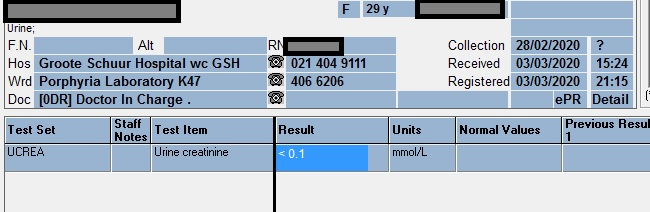
Upon signing blood results out, a creatinine result was measured by the analyzer as <0.1 mmol/L on a urine sample.

History

Clinical History was not available, but in my personal experience at the time, I haven’t seen such a low urine creatinine yet.

The possibilities in my mind, was that this was either a serum sample and could perhaps be incorrectly sent / registered from the Porphyria lab as serum, hence the result being < 0.1 mmol/L (<100umol/L if translated into serum reporting units).

Examination

The sample smelt and looked like urine. According to our new registrar, Mrs. Mariam Mahomed, it also tasted like urine. I was personally not capable of this task, so we decided to rerun the sample.

Mrs. Bilqees Jacobs, our technologist on the bench this day was of opinion that when such a low result is seen, it is usually due to a bubble aspirated by the analyzer’s sampling probe.

Laboratory Investigations

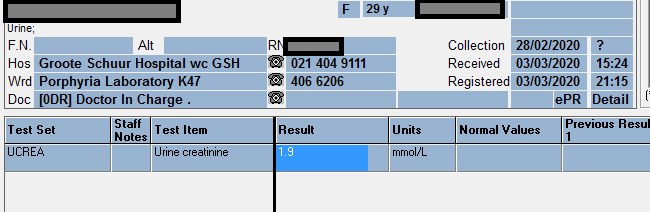
The rerun of the sample as a urine creatinine gave the result as 1.9 mmol/L, more in keeping with a true urine creatinine result.

Other Investigations

None was necessary, but should the result have been < 0.1 mmol/L on the rerun, we would then have run the sample as a serum on the analyzer to more accurately quantify the value.

Final Diagnosis

Possibly, a bubble was aspirated by the analyzer’s sampling probe and hence it did not pipette enough sample into the reagent well, or likely not pipette any sample therein.

Take Home Messages

Try to avoid bubbles in samples.

This brings me to the point: whenever a ” lower than detection limit” is seen, think of the cause:

“Tiny Bubbles!”