A case of raised PSA with ALP

HOSP # Lab no. SA04016354 WARD Orthopaedic Clinic
CONSULTANT   Jody Rusch DOB/AGE 61y Male

Abnormal Result

PSA: 846.5 ug/L

ALP: 284 U/L (53 – 128)

Presenting Complaint

Painful ”lumps” in groin + constipation

Spine pain

History

Smoker (>45 years)

No other co-morbidities

6/12 history of generalized body pain (mostly spine)

Red Flags (weightloss, night pain not responding to analgesia)

Examination

O/E: Pallor (Hb 8.6), Wasted. Clinically painful bilateral inguinal lymph nodes PR: normal tone, no masses, no blood, prostate smooth

Laboratory Investigations

Na 138  mM
K 4,7  mM
Cl 101  mM
Urea 10,3 mM
Creat 69  uM
eGFR by MDRD >60  ml/min/m2
eGFR by CKDEPI 97  ml/min/m2
Ca 2,26  mmol/L
Mg 1,03  mmol/L
Phos 1,01  mmol/L
Total prot 73  g/L
Alb 37  g/L
Total bili 3  umol/L
Conj bili 2  umol/L
ALT 15  U/L (10-40)
AST  19  U/L (15-40)
ALP 284 U/L (53 – 128)
GGT  76 U/L (<68)
LD 345 U/L
CRP 52 mg/L (<10)
Total PSA 846.5 ug/L (<4)
TSH  1,33  mIU/L (0.27 – 4.2)
Hb 5.6 g/dL
MCV 88.3 fL
WCC 7.57 cells/uL
Table 1 – Blood results on 06/07/2020

Other Investigations

Chest X-Ray: Left hilar opacities

X-ray of the limbs: Global lytic lesions involving both proximal femurs

Figure 1 – Lytic lesion seen in the centre of the thoracic vertebral body.
Figure 2 – Included for comparison with Figure 1 – not as big lytic lesion seen.
Figure 3 – MRI image of the same thoracic vertebral body as shown in Figure 1.
Figure 4 – Transverse and coronal views of the CT scan with the outline of the prostate marked in yellow (left middle) and purple lines (right top and bottom)
Figure 5 – Small lytic lesions visible in the proximal femur.

Prostate biopsy

  • MACROSCOPY: Specimen consists of two cores, the longest measuring 12mm in length.
  • MICROSCOPY Sections show 2 prostatic cores, both infiltrated by a prostatic adenocarcinoma.
  • % Ca core 1: 90%
  • % Ca core 2: 60%
  • Gleason score: 5 + 4
  • Grade group: 5
  • High grade PIN: Not seen
  • Seminal vesicle: Not seen
  • Perineural invasion: Present
  • Fat (extraprostatic) involvement: Not seen
  • PATHOLOGICAL DIAGNOSIS:
  • Prostate, needle biopsy: Prostatic acinar adenocarcinoma

Final Diagnosis

Metastatic Prostate Carcinoma with multiple metastases to the bones (thoracic spine and both femurs).

Take Home Message

Prostate-specific antigen (PSA, also known as kallikrein III, seminin, semenogelase, γ-seminoprotein and P-30 antigen) is a 34-kD glycoprotein produced almost exclusively by the prostate gland. It is a serine protease enzyme.

Most PSA in the blood is bound to serum proteins. A small amount is not protein-bound and is called ‘free PSA’. In men with prostate cancer, the ratio of free (unbound) PSA to total PSA is decreased. The risk of cancer increases if the free to total ratio is less than 25%.

The lower the ratio is, the greater the probability of prostate cancer. Measuring the ratio of free to total PSA appears to be particularly promising for eliminating unnecessary biopsies in men with PSA levels between 4 and 10 mg/L.

ALP (alkaline phosphatase) is well known to be a marker of ductal hepatic damage. ALP, being an isozyme, however has its origin from various tissue sources in the body. It is present in the liver, bile duct, kidney, bone, intestinal mucosa and placenta. The majority of ALP in serum is from either skeletal or liver origin. In adults the major form is from liver and in children the major form is from the skeleton.

Blood levels of alkaline phosphatase increase by two to four times during pregnancy. This is a result of additional alkaline phosphatase produced by the placenta.

If it is unclear why alkaline phosphatase is elevated, isoenzyme studies using electrophoresis can confirm the source of the ALP. It would likely in this patient be quite clear that the raised ALP would be due to the excess leakage from the osteolitic lesions from the metastases, but who knows, the patient may have had a beer or five in the preceding 3 weeks leading up to the bloods being drawn. The fact that the other liver enzymes are near-normal, makes alcohol consumption less likely though.


A case of severe hypoalbuminaemia

HOSP # Lab no: SA03948371 WARD Paediatric Ward
CONSULTANT   Dr. Jody Rusch DOB/AGE 16 y Female

Abnormal Result

Albumin of 8 g/L

Presenting Complaint

Signs and symptoms of a urinary tract infection made the patient present to a general practitioner.

History

No known chronic medical illness were present upon initial presentation.

No medical treatment was being taken for chronic illnesses.

The patient had reported taking NSAIDS before for pain in the lower abdomen. The exact drug / dose was unknown.

Examination

All clinical findings are unfortunately not available for this patient.

It is known that the patient had been having lower abdominal pains upon presentation (which was not due to pregnancy).

A urinary tract infection was suspected by the initial treating physician. Upon the other finding of edema, investigation towards the cause was investigated.

Typical findings of nephritic syndrome are:

  • Fever
  • Edema (due to hypoproteinemia)
  • High blood pressure (due to activation of the renin-angiotensis-aldosterone system).
  • Joint pain
  • Muscle pain
  • Malar rash
  • Foamy urine (proteinuria)

Laboratory Investigations

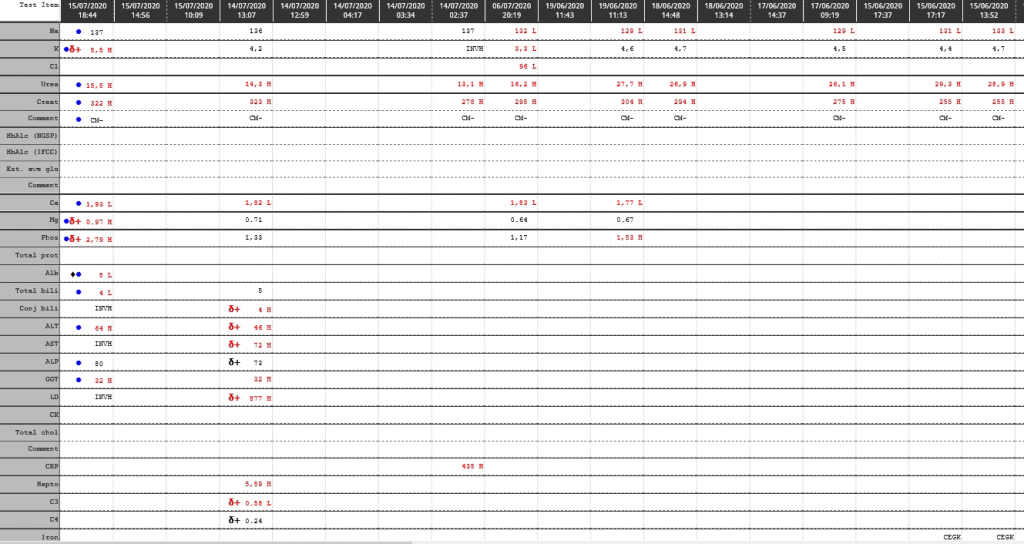
Albumin 14 g/L

Cholesterol 8.14 mmol/L

Urine Protein:Creatinine ratio: 1.62 g/mmol creat

C3: 0.29 (Low)

C4: 0.07 (Low)

Creatinine 255 – 322 umol/L

Other Investigations

Final Diagnosis

Lupus Nephritis with hypoalbuminemia

Take Home Message

The clinical presentation of this patient is a good example of the findings in patients who initially present with renal failure. The extent of renal failure is often so severe, that when the patient presents with signs and symptoms of renal failure, there are quite significant permanent renal damage already.

Patients with nephrotic syndrome present with significant proteinuria with resultant hypoproteinemia, firstly hypoalbuminemia, followed by the other bigger proteins like gammaglobulins, alpha-1, beta-1 and beta-2 (complement) proteins. Because alpha-2 (macroglobulin) comprises one of the biggest proteins (in molecular size) in the serum, it generally stays in the serum relatively longer than the other leaking proteins.

Because the liver increases its production of proteins to try compensate for the reduction in osmolality, the production of VLDL rises significantly and hence Triglycerides (and cholesterol) rises. Thus cholesterol in this patient measured 8.14 mmol/L.

The pathophysiology of lupus nephritis is that of autoimmunity. Autoantibodies direct themselves against nuclear elements. The characteristics of nephritogenic autoantibodies are antigen specificity directed at the nucleosome. High affinity autoantibodies form intravascular immune complexes, and autoantibodies of certain isotypes activate complement. Hence the C3 and C4 which are low often indicates active lupus disease.


Section 7.7 – Laboratory Management

Presentations attended related to laboratory management:

PathCape 2018

  • Accreditation, Quality and Leadership – Prof A Zemlin – PathCape 17 August 2018
  • Error Free Lab Work: Is it an achievable target? – Prof Yenice (Turkey) – PathCape 17 August 2018
  • P4P (pay for performance) in Laboratory Medicine – Dr Orth (Germany) – PathCape 17 August 2018
  • Accreditation – Prof Zima (Czech Republic) – PathCape 17 August 2018

Laboratory management course – University of Stellenbosch 02-05 November 2020

The laboratory management course which I attended through Stellenbosch University was an exciting experience. Although during COVID times, it wasn’t necessarily a trip to Stellenbosch where one could have a glas of wine at a local wine farm afterwards, but nonetheless it was an amazing experience. I have made friends with colleagues in other Pathology disciplines remotely and we needed to prepare a Strategic Business Plan and present it at the end of the course.

All talks attended were focussed on laboratory management. The skills learnt during this course will likely still bring much joy and productivity into my work life in future and the tools learnt to properly manage a laboratory are of enormous value.

There were tasks from as simple as a left-right quizz, to a QC workshop for our chemical pathology registrars with Levy-Jennings chart interpretation and the lot. Some of the most enjoyable topics for me were: Adding value to lab medicine, a topic often focussed on by Prof Annie Zemlin, effective laboratory leadership, focussed on by Prof Rajiv Erasmus, an effective laboratory leader in Chemical Pathology and the topic on Risk management by Prof Preiser. Together these topics which were presented (see below) made up an astounding course which brought together a few aspects rarely covered by other lecturers or even reading material elsewhere. This is what makes this course a must for future laboratory leaders.

Day 1 – 02 November 2020
Talk 1 – Leadership Skills For Effective Laboratory Management – Mandela’s Lessons – Prof RT Erasmus
Talk 2 – Laboratory Organization – Best Practice – Dr Z Chapanduka
Talk 3 – Ethical Leadership – Prof RT Erasmus
Talk 4 – Strategy And Leadership Strategic And Goal Planning For Effective Laboratory Management – Prof RT Erasmus
Talk 5 – Budget And Introduction Of New Tests – Prof AE Zemlin
Talk 6 – Laboratory Safety – Prof TS Pillay

Day2 – 03 November 2020
Talk 1 – Leading And Managing Change In The Laboratory – Prof G van Zyl
Talk 2 – Leadership And Diversity – Prof AE Zemlin
Talk 3 – Preventing And Managing Conflict In The Laboratory – Prof Schneider
Talk 4 – Risk Management In The Diagnostic Laboratory – Prof W Preiser
Talk 5 – POPIA For The Healthcare Professional – Dr C Swanepoel
Talk 6 – EBLM and Audit – Dr T Jalavu

Day3 – 04 November 2020
Talk 1 – Use Of Quality Management Tools To Assess And Improve Quality – Prof A Whitelaw
Talk 2 – Iso 15189 And Preparing The Lab For Accreditation – Prof AE Zemlin
Talk 3 – Non-Conformances & Document Control – Dr AA Khine
Talk 4.1 – Lean Management And Quality – Dr AA Khine
Talk 4.2 – Six Sigma Approach To Quality – Dr AA Khine
Talk 5 – Managing A POCT Service – Prof A Whitelaw
Talk 6 – Method Validation – Dr M Hoffmann
Talk 7 – Extra-Analytical Errors – Dr E Kruger

Day4 – 05 November 2020
Talk 1 – Harmonization, Standardization And Traceability – Dr T Jalavu
Talk 2 – Electronic Gatekeeping – Dr H Vreede
Talk 3 – Medico-legal aspects of laboratory practice and maintenance of the chain of evidence – Prof J Dempers
Talk 4 – Autoverification – Dr H Vreede
Talk 5 – Demand Management – Prof AE Zemlin
Talk 6 – Uncertainty Of Measurement – Dr E Kruger