A case of hyperuricemia in the ICU

HOSP # WARD Surgical ICU
CONSULTANT Heleen Vreede / George van der Watt   DOB/AGE 30 year Male

Abnormal Result

The result upon the query being raised by the reviewer was a uric acid of 0.95 mmol/L (0.21-0.43 mmol/L). Three days prior to this result, the patient had a uric acid serum concentration of 0.38 mmol/L.

Presenting Complaint

The patient presented to the hospital with a history of a swollen tonsil unilaterally. This worsened over few days to a severe infection (sepsis) as described below.

History

No significant history. Patient reported sober habits.

Examination

At initial presentation, the patient appeared to have a suppurative tonsillitis. The tonsillitis later developed into a retropharyngeal abscess and soon extended into the thorax, forming a pericardial abscess, which is what was found clinically at the time of admission to Groote Schuur Hospital.

Laboratory Investigations

Date: newest to oldest (only chemistry results included)

Other Investigations

CT scan: images to follow

Final Diagnosis

Retropharyngeal abscess progressing to a thoracic abscess and causing overt signs and symptons of heart failure.

Patient required a thoracotomy and pericardial drainage of the abscess.

Take Home Messages

  • Do not take tonsillitis lightly. If not adequately managed, it may cause serious complications.
  • Elevated Uric acid is a risk factor for acute kidney injury. This may be by means of acute gouty crystal deposition, but other crystal-independent roles has also been described.
  • Uric acid concentration will rise significantly in severe infection, most likely due to the fast tempo of tissue or DNA turnover, both by bacteria and host tissue breakdown and repair. Uric acid is a product of the metabolic breakdown of purine nucleotides.
  • Uric acid, being a heterocyclic compound, I thought could interfere in various assays, and I thought even in the Jaffe reaction for creatinine, but it doesn’t seem to be a common interferent when doing a quick literature search.
  • Uric acid appears to be the major anti-oxidant in human serum constituting around 61% of total anti-oxidant activity, evidenced by Maxwell et al.:
  • Relative contribution to total serum anti-oxidant activity in this study was: urate 65.1%, vitamin C 8.7%, vitamin E 10.6%, vitamin A 5.7%, thiols 7.8% (as in albumin) and bilirubin 1.9%.
  • One immediately thinks that a patient with such a rapidly progressing infection has to be immunocompromised, the most common cause(s) in South Africa being HIV or diabetes mellitus. This patient however was HIV negative, according to HIV ELISA and did not have reported signs and symptoms of diabetes.
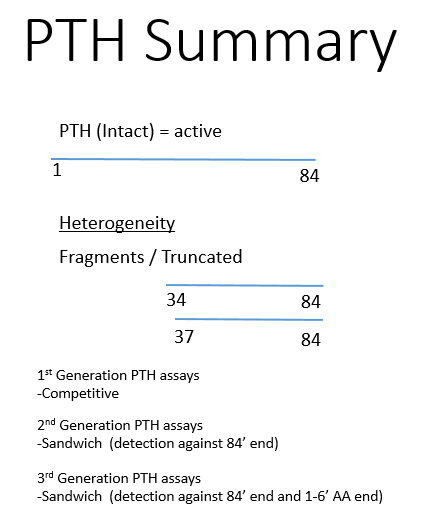


PTH Summary

Dr. Jody Rusch’s simplistic explanation of PTH and its measurement

n-truncated are deficient in the first few aa’s (7-84) – hence biologically inactive.

1-11 aa sequence is necessary for function.

Different assays:

  • Intact PTH measurements: 7-84 and 1-84
  • Bioactive PTH: 1-84
  • CAP assay: cAMP inducible PTH. This assay determines the biologically active PTH by its ability to induce cAMP.
  • PTHrP assays and PTH assays are exclusive to each other by design.


A Case of Neurodevelopmental Delay

HOSP # WARD Neurodevelopmental clinic – Inkosi Albert Luthuli Hospital
CONSULTANT Prof. George van der Watt DOB/AGE 2y male

Abnormal Result

Urine organic acid analysis was performed upon which a big peak was seen, representative of phenylpyruvate.

Presenting Complaint

The patient was a 2 year old male evaluated at a neurology clinic for neurodevelopmental delay.

History

The patient’s brother died at 3 or 4 years of age with similar neurodevelopmental delay.

Examination

Unfortunately this information was unavailable. The clinician I got hold of at Inkosi Albert Luthuli hasn’t seen the patient himself.

Laboratory Investigations

Fig 1 – Urine organic acid screening by GCMS demonstrates elevations of the phenylketones: phenylpyruvate and 4-OH phenylpuyruvate. These findings are indicative of a diagnosis of phenylketonuria due to autosomal recessive deficiency of phenylalanine hydroxylase.

Other Investigations

The urine amino acid analysis yielded a significantly raised phenylalanine: 672 umol/L (ref <67)

Final Diagnosis

This is a case of phenylketonuria

The diagnosis is also supported by a plasma phenylalanine of 672 umol/L (ref < 67).

Take Home Messages

Build-up of phenylalanine gets metabolised to phenylpyruvate (which is seen in urine at high levels).

Phenylalanine levels >600 umol/L in serum is highly indicative of phenylketonuria

Prof. George van der Watt

Biopterin cycling defects usually cause levels >125 umol/L.

This deficiency is 4-monooxygenase deficiency.

Management of PKU is with a phenylalanine restricted diet.


Elevated anti-Thyroglobulin Antibodies

HOSP # WARD Oudtshoorn Clinic
CONSULTANT George van der Watt & David Marais DOB/AGE 66y Male

Abnormal Result

Presenting Complaint

Mr. X, a 66 year old male, complained of chest pain, was seen at the Oudtshoorn Emergency department and a myocardial infarction was excluded by three serial point-of-care (POC) Troponin I results.

History

  • Known with hypothyroidism, but the cause was not defined yet.
  • On Eltroxin 150 ug daily PO
  • No other treatment.
  • Various stool analyses had been sent in for culture, with no definitive result.

Examination

Unfortunately not known.

Laboratory Investigations

Free T4: 24.6 pmol/L (7.6 – 16.1 pmol/L)

Anti-Thyroglobulin Antibody levels were elevated at 1944 U/mL (ref. <115 U/mL).

Other Investigations

Later, by retrospective viewing of the patient’s results it was revealed:

Total Cholesterol (TC) was elevated at 7.6 mmol/L. Hypothyroidism is associated with hypercholesterolemia. It can be concluded by the retrospective overview of results that upon an episode of hypothyroidism, the patient had hypercholesterolemia. This was most likely due to cessation of Thyroxine treatment, to whatever reason.

Index sample marked by the yellow shade. TC result which is raised (upper left corner) corresponds to the severely hypothyroid episode as revealed by the low T4 on that same sample.

Investigations also confirmatory for auto-immune hypothyroidism are:

  • Anti-Thyroid peroxidase antibodies
  • Anti-TSH receptor antibodies

Final Diagnosis

Auto-immune hypothyroidism

Take Home Messages

Interestingly, numerous patients with hypothyroidism is diagnosed at our Lipid Clinic at Groote Schuur Hospital. Patients are being referred for hypercholesterolaemia. Generally referral to this clinic happens when TC > 7.5 mmol/L. These patients are referred as presumed to have familial hypercholesterolaemia, but upon further work-up it is found that many of these patients have long-standing untreated hypothyroidism.

Prevalences of antithyroid antibodies as summarized by Up-to-date:

Image result for auto-immune hypothyroidism antibodies"