Hyponatremia with a urine sodium measurement

HOSP # WARD Khayelitsha Hospital Emergency Unit
CONSULTANT   Dr. Heleen Vreede DOB/AGE 64y female

Abnormal Result

Serum Sodium of 124 mmol/L

Presenting Complaint

A 64 year old female, presented to the Emergency unit at Khayelitsha Hospital with worsening hyponatremia.

History

The patient had a prior cholecystectomy 6 weeks ago. Histology thereon has shown chronic cholelithiasis but it was complicated with a polyp in the galbladder and adenocarcinoma thereof (completely excised during the cholecystectomy).

Examination

Not available

Laboratory Investigations

Date 24/01/2021 23/01/2021 22/01/2021 11/01/2021 22/12/2020 04/12/2020 19/01/2016
Na        δ-  124 L   129 L   133 L   138     137         
Urea          3,9     3,1     6,1     6,1     8,2 H       
Creat           61   δ-   66      88      73      86      48 L
U Na •   31                                            
U K • 14,9                                            

Other Investigations

Liver enzymes were normal at the last measurement (23 January), inflammatory markers normal, COVID-PCR negative on 11/01/2021.

Unfortunately neither the volume status, serum nor urine osmolarity was available on this patient’s history.

Final Diagnosis

Urinary sodium loss in one form or another. The appropriate response in hyponatremia is to decrease urinary sodium loss. In this patient, the urinary sodium was 31 (should ideally be <20 mmol/L in hyponatremia).

Unfortunately only the urinary sample was sent to our laboratory and it wasn’t possible to assess serum osmolarity.

The volume status was also not available, which is one of the necessities to adequately interpret hyponatremia OR hypernatremia.

Take Home Message

Salt never goes without water – similarly Sodium shouldn’t be interpreted without the volume status of the patient, and the serum (or urine if applicable) osmolarity.

In hyponatremia one expects the kidneys to respond adequately and hold back sodium, hence decreasing urinary sodium (to <20 mmol/L).

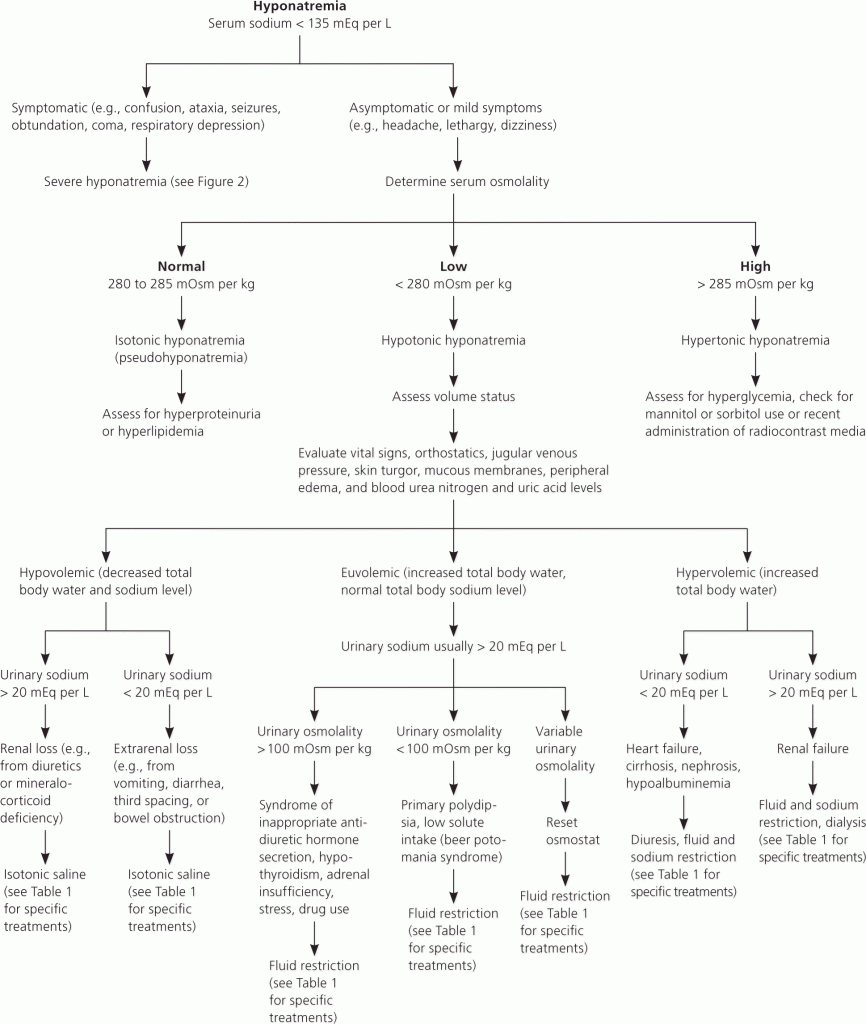
Assuming the patient’s osmolarity was low (by estimation formula) the following possibilities ensue:

Patient Hypervolemic: the high urine sodium points toward renal failure.

Patient Hypovolemic: Renal loss (diuretics / mineralocorticoid deficiency)

Patient Euvolemic: Urine osmolarity should be measured:

Urine Osmol >100: SIADH; Hypothyroidism; Hypoadrenalism (although urine Na usually >30); Stress ; Drug use.

Urine Osmol <100: Primary polydipsia / Beer Potomania syndrome

Variable urinary osmolarity: Needs a “reset” of the osmostat by fluid restriction.

Furthermore: Indicators of renal insufficiency in this patient is the increased creatinine above the patient’s baseline of 48 uM. The creatinine has risen to 88 uM on one occasion. Although not above the reference interval for women, this value constitutes a (88-48)/48 = 83% increase in the creatinine and likely will indicate Acute Kidney injury, probably one of the most overlooked causes of morbidity in hospitalised patients in my opinion.


Beta-HCG’s half life

HOSP # WARD Labour Ward
CONSULTANT   Dr. Jody Rusch DOB/AGE 23 y Female

Abnormal Result

The beta-HCG measured 1.3 million IU/L initially, then decreased significantly after an induced abortion.

Presenting Complaint

A 23 year old lady, at 36 weeks gestation presented with signs and symptoms of Hyperthyroidism. She also had a “retained placenta with hydatid mole” quoted from the request form

History

The patient presented with a gradual onset of hyperthyroidism signs and symptoms during the pregnancy.

Examination

Retained products of conception. This was subsequently removed and sent for histology (see below).

Laboratory Investigations

Episode SA02847149 SA02854036 SA02854698 SA02863861
Date 14/03/2019 17/03/2019 18/03/2019 20/03/2019
Time 13:03 00:47 01:12 15:37
Beta-HCG 1 319 797 203 195 81 165 21 567 

Other Investigations

Histology

MACROSCOPY:
Specimen consists of a large amount of placental tissue fragments with grape-like structures noted, the largest measuring 14mm in diameter. The largest fragment of tissue measures 155 x 50 x 35mm. The entire specimen weighs 374g.

MICROSCOPY:
Sections of placental tissue demonstrate heterogeneity in villous size with large, hypertrophic villi and small fibrotic villi identified. The enlarged villi are irregularly shaped with scalloped borders, and cistern formation. Circumferential mild trophoblastic hyperplasia is noted in some of the villi. Foci of micro-infarction are noted. Overall features are consistent with a partial hydatidiform mole.

PATHOLOGICAL DIAGNOSIS:
Retained products of conception (placenta), biopsy:

Final Diagnosis

  • Gestational trophoblastic disease, consistent with a partial hydatidiform mole
  • Hyperthyroidism likely due to the similarity of the alpha subunit in HCG to the alpha-subunit of TSH, hence stimulating the TSH receptors.

Take Home Message

Graph illustrating the decrease in the B-HCG values on subsequent days after initial measurement on the day the products of conception was removed by dilatation and curettage (day 0).

According to the only source I could find during a quick literature search, I came upon the phrase:

Plasma beta-HCG concentration falls according to a multi-exponential curve with a half-life of 0.63 days in the first 2 days following induced abortion, and of 3.85 days in the subsequent 14 days

van der lugt et al – Disappearance of HCG after induced abortion, 1985

Considering the above, I endeavoured on the task of calculating the half life of the HCG between the 4 time points using Prof Pillay’s method:

F=0.5^(t/T), where F=fraction left, t=time difference and T=half life (units to be kept constant for t and T).

An important log-transformation rule to remember in this case is the logarithm power rule:

Logarithm power rule logb(x y) = y ∙ logb(x)

Thus to calculate the half life between two time points (after rearranging formula above):

T= (t * log(0.5)) / log(F)

Hence

Between days 0 and 2.5:

T = (2.5 * log(0.5))/ log(203 195/ 1 319 797)

  • T (or half life) = 0.92 days

Similarly between days:

  • 2.5 and 3.5: T= 0.76 days
  • 3.5 and 6.15: T = 1.39 days

This corresponds fairly to the quoted 0.63 days which increases on subsequent days after abortion.

The discrepancy could likely be explained due to:

  • some degree of high dose hook effect at the high HCG concentrations,
  • high coefficient of variation at high immunoassay analyte concentrations with assays using a sigmoidal calibration curve,
  • variation in the methods of abortion compared to or
  • gestational age upon which abortion is done, to name a few.

Nonetheless the above equation from Prof Tahir Pillay is useful to calculate half life.

It is important to screen for hyperthyroidism in patients with hydatid moles and ensure that the TFT’s return to normal when the HCG returns to normal.